I retired in April 2013 after 25 years as a librarian at the British Library specialising in inventions. This included running numerous workshops; writing books on inventions and a work blog; carrying out searches for clients; and one-to-one meetings with inventors. [more]

[ABOUT ME] [CONSULTANCY WORK] [FAVOURITE LINKS] [BOOKS] [CONTACT]

Showing posts with label Patents. Show all posts

29 December 2016

Amazon and its "airborne fulfillment center"

I've just heard about Amazon's astounding patent Airborne fulfillment center utilizing unmanned aerial vehicles for item delivery. It uses an airship warehouse that deploys drones, or UAVs, to deliver packages to nearby addresses. Other vehicles would replenish the airship at intervals.

It was published as long ago (well, about eight months) as 5 April 2016 as a granted American patent, having been filed in 2014, but is described as a filed application in the BBC news story, published today, Amazon files patent for flying warehouse. Wrong, it has rights in the USA (but was apparently not filed abroad, so can be used there unless the idea can be shown to have been disclosed before the filing date). Below is one of the 13 pages of drawings from the 27 page patent specification.


Wow ! They really seem to be serious about the idea. Amazon's published patent applications and grants in the area of aviation from the year 2000 to 2016 are listed, in filing date order (most recent first). All 36 of them. There may be some duplication -- I usually only select World documents but Amazon usually uses the US system which confuses matters.

It's interesting to see that some are about keeping the noise down, perhaps to overcome possible objections. One patent application, published in September 2016, is the interesting Landing of unmanned aerial vehicles on transportation vehicles for transport -- landing them on truck roofs.

Other patents concern authenticating messages sent to the drone. Presumably there would be problems with hackers at random ordering drones to deliver to them ? Or perhaps trying to damage the company's image.

Like the concept of automonous vehicles on roads, unmanned aerial vehicles need to be trusted as being reliable. Amazon Prime Air is the name of the experimental service. My concern is, how does it get to the actual customer -- is the package left on the doorstep, how is the customer supposed to know it's arrived, and so on.

27 August 2016

Innovators working together

The Daily Telegraph today alerted me to a paper by an academic at Brown University in the USA, Anton Howes.

His The improving mentality: innovation during the British Industrial Revolution, 1651-1851 has a sample of 677 innovators. He found that at least 83% shared innovation, rather than keeping everything to themselves. It looks like a very interesting and important paper.

Some might have done so because of the patent system although that was weak for the period covered. It reminds me of the Isaaac Newton argument that "if I have seen further it is by standing on the shoulders of giants." Again and again products and processes are improved or cheapened by others coming up with what might be incremental changes.

Nowadays it is normal to have multi-disciplinary teams carrying out research because no one person is likely to have sufficient knowledge or skills to devise a fully workable and cost-efficient solution to a problem. Like Biro, inventor of the first workable ballpoint, whose chemist brother assisted with the ink formulation.

I haven't yet read the full paper (I only heard about it ten minutes ago) but I noticed its comment that between 1765 and 1845 patented inventions were not allowed to win prizes awarded by the Royal Society of Arts. It could be argued that by having a patent you were publicising your invention -- except that until the 1850s that was no systematic printing of patents, although some appeared in magazines, especially from about the 1820s onwards.


9 February 2016

Designs of the Year 2015

Each year London's Design Museum hosts the Designs of the Year exhibition. The 2015 exhibition opened last March but I've only just got around to seeing it (it closes 3 April 2016).

As usual there was an interesting and stimulating mixture of built objects or design concepts from around the world. A few criticisms: I didn't notice any mention of cost, whether to the manufacturer of the consumer. Some excellent ideas have failed because the cost can't fall to the price that consumers are willing (or able) to pay. It often isn't clear if a design is merely a concept or a proven, and available, product. Design is by manufacturing and selling as well as looks and function. And it would be good if it was easy to find more information, such as (dare I say it ?) patent specifications.

There is for example an inflatable airbag jacket by Italian company Dainese, as illustrated here: the D-Air® Street.


There are a number of World patent applications by Dainese concerning inflatable inventions. The idea is that sensors on the fork of a motorcycle anticipate a collision, They send a wireless signal to activators in the cells of the jacket, which inflate in just 45 milliseconds. The jacket is powered by a battery which can be charged using a USB connector. There is a webpage by Dainese about the product, which is already available.

The concept of airbags for motorcycle users is an intriguing one, and I have posted before on the subject, with the Hovding airbag helmet.

Another invention is a new kind of coffee maker, as illustrated below.


This is Miito, by Danish designers Nils Chudy and Jasmina Grase. Most people grossly overfill kettles and hence boil far more water than they actually use in the hot drink. Even if they keep to the recommended filling line, they are making enough hot water for two cups and not just one. This device has an induction base which uses electromagnetism to heat the base of the rod while it is inside the cup and hence the liquid contents. It powers down when the water boils, or the rod is removed. I like the cool simplicity of the idea. Of course, it won't work if you are making cups for more than one person. You can reserve one for 25 Euros.

The Google autonomous car was also there. I must admit to doubts about this concept, if only because if there is a crash, who is liable, as no one is actually driving the car ?

The exhibition encourages people to vote for their favourite design, with totals given on a board. When I visited the most popular was The Ocean Cleanup, by three Dutch designers. Huge booms attached to the seabed use ocean currents to sweep pieces of plastic and other debris to a containment area 40 km long, shaped like a giant V, where the material is compressed and later removed. While the idea of dealing with this growing problem is laudable, I wonder at the cost if the seabed is deep below the surface, and about hazards to shipping. Still, I hope it works. There is a lot of information about this solution at The Ocean Cleanup website, which says that a trial in the North Sea will take place in 2016.

If you are near London, I strongly encourage visiting the exhibition and letting a flow of ideas pour over you.

13 January 2016

Brick-laying robots

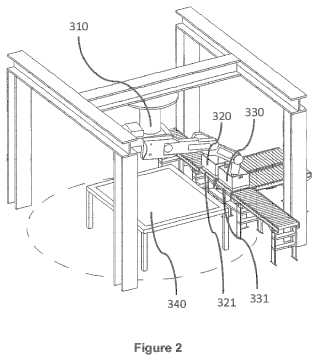
Increasingly we are seeing repetitive tasks carried out by workers being replaced by robotics. This can even involve skilled workers, such as bricklayers. Mark Pavic of Western Australia, an aeronautic and mechanical engineer has with a colleague devised a brick-laying machine.

The story is told in a Gizmag story, Brick-laying robot can build a full-sized house in two days. The robot, Hadrian, can lay 1000 bricks an hour. Pavic's brother Mike is CEO of Fastbrick Robotics who intend to launch a commerical version in 2017.

It was as long ago as 2007 hat the world patent application for the concept was published, WO2007/076581. Below is the main drawing.

So, how could you have found such a patent document ? The classification is based on the idea of "manipulators" which could be run together with the word brick* to get a good list of relevant material. B25J9, programme-controlled manipulators, looks particularly attractive.

Once you know of a patent document, you can check to see what happened to it in specific jurisdictions. In this case US8166727 was granted protection in 2012. The pan-European granted document, EP1977058B, was published in 2014, and the documents to do with its allowance are given in the relevant European Register entry.

Anyone wondering at the time if the patents would be allowed could have looked at the prior art as listed by patent examiners -- this is given as "cited documents" on the left hand side of the bibliographic entry for the European A document.  22 are listed for that one. It might be thought logical that all prior art cited is given there, but no, each "also published as" document needs to be clicked on and a fresh window appears. Some countries, such as the USA, do not list cited patents at the initial A stage but only at the granted, B stage.

Just as you can find the prior art by clicking on "cited documents", you can find those that later referred back to the one you know of by clicking on "citing documents". This tells us that none cited the European; but for the US A and also the B document there are 9, and for the original WO document there are 6. You would have to compare the lists to figure out which were on both lists -- they are likely to be particularly significant.

Those with specialist knowledge of the area would then have to interpret the results, so long as those who understand the published patent documentation and its associated patent procedure can explain what to look out for and implications. Both are needed. When I worked in the area, it always surprised me how many inventors thought that they could do it all themselves, or just spend 20 minutes or so looking through the patents before committing to thousands of pounds of expenditure and huge amounts of time. Rather like carrying out brain surgery on yourself, perhaps ?


11 January 2016

Unventional: Ideas too good to patent, book review

Some books about inventions are serious and are designed to enlarge knowledge. Some books about inventions inspire.

And then other books are just plain fun. Madcap, even.

Unventional: Ideas too good to patent by Tom Giesler is definitely in the last category, with madcap humour and superb drawings of Rube Goldberg-like (or, in the UK, Heath Robinson) inventions which are just a bit wacky. They are in the same style as many real patent draftsmen working for inventors to show how the inventions work. This is not a coincidence: besides being an artist, Giesler is himself a patent draftsman. And he even lives in California -- isn't that the place where the crazies come from ? (Just kidding, my wife grew up there).

When I was a patent specialist at the British Library, I had to emphasize how serious and important inventions were, and keep a straight face when someone explained a silly idea. No longer ! Freeze-cones, diaper bowls, burger sheaths -- inventions no one is likely to really need are seriously explained, thought through and illustrated here just as much as worthwhile inventions are explained in the Real Thing on numerous databases. It's the sort of book I'd have loved to have written if I had any artistic talent at all.

Below is a delightful, short trailer about the book.


The book can be bought through the Unventional website.

1 December 2015

Ocado, the UK online grocer

Ocado is the leading UK online grocer. Its business consists in trying to make money from packing groceries and related items for customers and delivering it to their homes,

I remember being skeptical about their business model when they started in 2000, founded by three former merchant bankers from Goldman Sachs. From 2002 they worked in partnership with Waitrose, an upmarket supermarket chain, and in 2010 they were floated on the stock exchange. I see that in 2014 on a revenue of £948 million they had a razor-thin profit before tax of £7 million -- a margin of under 1%.

Clearly, controlling their costs is crucial as there is only just so much that customers are willing to pay as a premium for having their groceries delivered. They only have two warehouses: one in Hertfordshire, and the other in Warwickshire. Inventions have been used to ensure an efficient environment for collecting the groceries to fulfil the orders.

This is a list of British patent specifications by Ocado.

Here are a few of the drawings. A picking station:


This is for units that move in two directions above the storage units:


At the time of writing, eight out of ten documents found had as the inventor, or one of the inventors, a Swede called Lars Lindbo. Very often, when a company's technology is of interest, it turns out that there are one or two significant inventors who might perhaps be poached.

Their website, too, is simply a tool for ordering groceries and supplies, and has constant discount offers. It has features such as remembering what was ordered before so it is easy to reorder. When  you are ready to check out you can select a time slot for delivery, 6 in the morning to 10 at night, whichever is best for you -- at no extra charge if you can be flexible by picking a time when the van is in your area. Disclosure: we have used it ourselves, with deliveries at say noon -- one of the perks of being retired.

29 November 2015

The problems of private inventors: "New Scientist" in 1979-80

In looking up a reference recently I came across a couple of articles on British private inventors in New Scientist dating back to 1979-80 (freely available on Google Books).

They were about the frustrations experienced by inventors trying to get their ideas commercialised. Things haven't changed: my career as a patent librarian began in 1987 and ended with my retirement in 2013, and complaints about a lack of enthusiasm for private inventors' ideas were a constant refrain.

The articles reminded me that many inventors would say to me that the government should pay for evaluating, promoting and often financing their inventions. Strangely, none of them volunteered that the government would then deserve a big cut of any profits for taking such risks. I always felt that many private inventors were unable to understand the feelings and motivations of those on the other side of a bargaining table, and that success was very unlikely without some empathy.

The articles I found were both by Adrian Hope, who in 1980 revealed himself to be Barry Fox, a journalist who specialised in electronics and who took a great interest in the patent system. They are It's a wonderful idea, but... (1 June 1978, 576-581) and Death of an idea (13 September 1979, 794-797, with comments by inventors in the 27 September issue, page 1000, Hope springs eternal).

They make entertaining reading, if it is rather frustrating to see good ideas that at the time at least never got anywhere. The first article was promoting the idea of an organisation that would "provide desperately needed funds and encouragement" for selected inventions by private inventors. The problem, surely, would be to identify the possible winners: if it was that easy, everyone would be doing it.

The article began with Hope explaining that he wrote to the inventors of 65 patented inventions which had been profiled by him in New Scientist. 29 of them were still in force (occasional renewal fees were required), 20 had lapsed from protection, the remainder were too new to be subject to renewal fees. Only 33 replied, although Hope used the latest addresses as listed in the Patent Register.

Of the 28 replies relating to "small" inventions, 8 were handwritten, and many were rambling and mentioned irrelevant matters (I always reminded inventors that no manufacturer would be interested in how or why you thought of the idea...). Hardly business-like, and I liked Hope's comment that inventors can be their own worst enemies. What they had in common was that they were frustrated by the "brickwalls" in trying to get the idea into production or use.

One such invention was GB1288677, Means for protecting water pipes from bursting under freezing conditions, a simple means of doing just that. Another was a musical potty to help mentally disabled children, GB1409803, Chamber pot. That may sound amusing to some, but a woman inventor later made a lot of money from such a device that talked to the children to encourage, ahem, good aim. This is a list of mostly relevant patent documents on talking or musical potties.

The article concluded by recommending a scheme by which prizes of £5000 would be awarded after evaluation. The National Research Development Corporation (NRDC) had a somewhat similar role but for larger-scale inventions, and it was disquieting that many inventors said at the time that they had never head of it.

The second article was an interesting followup. The NRDC was only interested in strongly protected inventions, often not the case for small inventions, and they needed to be potentially valuable. Their investment in the hovercraft had not earned money, and apparently it was only their investment in patents in cephalosporin drugs which had made it profitable. Which confirms my point that it is very hard to pick out the "winners". Perhaps only inventions which save money for the user or the taxpayer, or which help the environment, should be picked ?

The NRDC is no more, and Nesta, founded in 1998, is the UK agency which comes closest to it, although with a wider remit. Its Our history pages list some of its achievements.

There is also the idea of a Royal Academy of Invention, for evaluating inventions, which has been promoted by Trevor Baylis, the "clockwork radio" inventor. He has not made much progress with the concept.

So, business as usual...

22 August 2015

Adaptahaus: Grand Designs and a prototype house

I've just been watching an old Grand Designs episode about Alan Dawson's prototype house, Adaptahaus. It was built in Cumbria in a few weeks, back in 2009.

Presumably named for the super-ecological Passivhaus concept from Germany, it is an ingenious way of building efficient houses in high volume. This is what the finished product looked like: it cost about half a million pounds although that included prototype work.


The idea was that the floors would be built on a grid basis to make things quicker and easier -- rather as in Japan rooms are measured by the number of tatami mats needed to cover the floors. Hence wooden spans were noticeable at set intervals in big rooms. Personally I found it a pleasing pattern.

Alan also applied for a patent, in May 2010 (odd if the episode was shown in 2009, as patent applications are made for new concepts, not those disclosed in TV programmes). An international patent application was published as Pre-fabricated building structure. Here's one of the drawings from it.


It was, however, withdrawn in 2012 as a European patent application and doesn't seem to have been granted elsewhere. This was presumably because three patent documents, two French and one Dutch (but in English), were found to have anticipated what Dawson's application was claiming protection for, as listed in this list, which also includes patent documents he was aware of. It shows how hard it is to look for prior art even though Dawson used a patent attorney. The French documents were more than 20 years old and hence could not be used to take legal action against Dawson, while the more recent Dutch application turned out to also be deemed withdrawn as they had not replied in time -- perhaps the list of documents in the European Patent Office correspondence offers hints. This was the sort of thing I was looking up for people all the time when I worked in the British Library.

Adaptahaus has its own website.

11 June 2015

A patent dispute: Eustace Vant and his father in law

It is unusual for patent disputes to involve taking your father in law to court. Here's a British one from World War I.

My source is the Evening Dispatch of the 20 July 1916, as found on the British Newspaper Archive while investigating Surbiton in World War I. Eustace Hazzel Vant had been a Captain in the Loyal North Lancashire Regiment who had been invalided out after being thrown from a horse. In 1915 he married Sybil Barton.

The 1911 census shows Sybil as a secretary for a ladies' club, age 26, living on Bond Street with a married typist. Her parents were in a 11 room house called Brooklands, in Lingfield, Surrey. Joshua Barton was 59, a company director of a match factory, living with his wife Annie.

Then on the 20 July 1916 a court case erupted in the King's Bench. 

Vant, of Surbiton, had given his father in law, Joshua Barton of next-door Kingston, Surrey, £100. That was not in dispute: what was uncertain was whether or not it was a loan, as Vant insisted, or an investment, as Barton asserted. 

Vant claimed that half of the sum was to be repaid in November 1915 and the balance in February 1916. He had obtained an overdraft from his bank on which he had to pay interest. 

Barton argued that the money was an investment in a collapsible lifeboat. It was agreed that Vant had tried to get the authorities interested in the invention, including a visit to Liverpool which cost him £4 in expenses (for which he was refunded). 

It sounds as if they did not have a written agreement, which was very foolish of both men, and is in fact close to unbelievable. Barton seems to have been well off and it is strange that he needed £100 from his son in law. 

Although the news account does not say so, it appears that Barton was the actual inventor. A few weeks after the sinking of the Titanic, GB1912/10787, Improvements in collapsable lifeboats, was filed by Joshua Barton of Brooklands, Lingfield, Surrey, director of a public company. A drawing from it is shown below.


Together with an engineer named Charles Hibberd he had been responsible for three earlier patents for cash registers and the like, and also for an earlier lifeboat invention, GB 1898/26927

So what happened ? The newspaper account only gives us the fact that the court case was on-going and not its conclusion. Not surprisingly, the marriage appears to have broken up. Vant remarried in 1918 and became a solicitor in the family firm in Settle, Yorkshire, and died in 1948, 

13 March 2015

British patents now available online at British Library

The UK Intellectual Property Office (IPO) has made available at the British Library, London PDFs of British patent specifications from 1617 to 1899 via a server located there. It is best to visit its Business & IP Centre to see them (and remember a pass is needed for entry to the library).

They are only accessible by asking for specific patent numbers rather than by using e.g. name, address, occupation or title. It is nevertheless a big advance on having to order paper copies and wait for them to be delivered. The entire specification loads very rapidly as a single PDF.

It also means that the paper copies at the IPO will be conserved from damage when requests for copies come in, besides the paper copies at the British Library.

I think it a shame it is not available elsewhere, such as at the patent libraries in the UK, or on the Web for anyone to use. Better still, it would have been good to have it added to the Espacenet database. There are precedents for having patents available only by using the patent number, such as early American and German patents.

At present Espacenet allows British patents to be requested from mid 1893. They can be ordered by patent number or by asking for GB in the publication number field and then by various other fields such as title and name.

3 March 2015

What's the perfect business plan for a new product ?

I had a meeting with an inventor about her product idea, and in our talking it occurred to me to put down what I consider the key points for a business plan for a new product. Although aimed at private inventors, it makes good sense for small companies too.

As the saying goes, if you fail to plan, you plan to fail. The outline given below is a simplification but a good start. I met many inventors in my time at the British Library and most, I'm sorry to say, were unrealistic and naive in their expectations. They did not realise how many experts they need to call on for help (much of which will be charged for). Nor did they think that exploiting an invention would take much time.

1. First is is vital to sort out what you are trying to achieve, and constraints in finance and time. All this may sound obvious, but keeping them in mind both informs and dictates the rest of the plan.

For example, is the prime motive making lots of money, to get an idea into production, to help the world with the invention ? Particularly if it is money, you have to take into account what economists call "opportunity cost" -- if you earn £50,000 p.a. and take a year out to earn £80,000 at a cost of £60,000 (the first figure is unrealistically high, the second is only too realistic), you've lost £30,000 in earnings. I once had a conversation with such a person who was convinced that income was profit.

In considering this, it is vital to think about what finances you have, your attitude to financial risk, and how much you are prepared to lose. Someone with £10,000 in savings will probably have a very different attitude to someone with £500,000. Are you prepared to say, "I will spend a maximum of £20,000" ? Many would say to me "I've gone this far, I can't give up now." That's what gamblers say, too.

Do you want to work long hours ? Chances are good that, regardless of making any money, you will be spending a lot of time on the project trying to get interest.

A timescale is also a good idea. Will you allow say a year, or two years, to get it off the ground ? That's not much time, and how is success measured ? That's your call.

2. The first of the four Ps (the other Ps are at the end of this list):

Product (what is it, why is it a good idea. Does it have a USP (Unique Selling Proposition) ?  Do people really need it, can they afford it ? Is the way it works important ? Its looks ? Both ? Does the product need to observe laws and regulations on safety, or to keep to technical standards ?) If you are not familiar with the industry, learn about it.

3. You should put together a SWOT analysis of your product and also of yourself. SWOT is a useful tool: it stands for Strengths, Weaknesses, Opportunities and Threats. In my one hour meetings with inventors when I worked at the British Library quite a few presented SWOT analyses of their product, but none offered a SWOT of themselves. Again and again they had the idea but no finance, no knowledge of accountancy or marketing or engineering... yet did not see any problem. Having weaknesses such as these won't necessarily kill the idea, but they make it harder for the inventor to succeed. My own preference was inventors who at least knew about engineering, and ideally worked with someone who knew about accountancy and/ or marketing.

In some areas, a PEST analysis of the product is also a good idea. It stands for Politics, Economics, Social, Technological. Think, say, of apps to summon cheap taxis. Perhaps the landscape has changed to suggest changes in products or processes.

4. Is it patentable ? A hugely complicated subject, and a patent attorney should be consulted. Many will offer an initial free half hour -- if so, make sure you ask questions like what will you do for me and how much do you charge for what. If it's not patentable then the odds against it being a success rise a lot. Do not reveal the idea except in confidence until you've filed for a patent, and if possible spell out the advantages instead of how it works. For example, you could say you have a new method of closing garments that operates without a zipper and which is easy for all to use.

5. Carry out a patent search, remembering that just because you thought of it doesn't mean it's not been thought of by someone before (I met someone who said he had written an idea down and locked the paper inside his desk, and was furious when he saw the product for sale a few years later. Clearly, he said, someone had burgled him). You can try doing a search online but it's better to employ an expert or at least ask someone at a public patent collection to advise you. Be prepared to take days searching and analysing the results (you will probably need help on this).

A useful starting point, particularly good for cheap products, is Google Shopping which can be used to rank by price products available through websites.

If'it turns out that the idea is protected in the country you want to sell in, give up. If not protected but it's out there already, that's a big strike against it. It greatly adds to the odds against success as competitors are either already out there or can easily compete.

6. What is your intellectual property (IP) strategy -- e.g. Europe and USA ? Patent, trade mark ? Add more countries if you like but remember that you'll need to translate the patent specification into the local languages, and probably advertising, brochures, etc. into them as well -- do you want to spend that ?

7. Make a working prototype. I can't remember how many times people would tell me that no they knew nothing about the industry, but yes, "in theory" the product would do the job. No need, they thought, to go to the trouble of making a working prototype to persuade a company to take them on. The problem is that they will immediately be shown the door.

If the prototype is to be shown at say a trade show or on Dragons' Den it needs to look good as well as working properly. Some companies offer to make prototypes and sometimes to help improve the product.

8. Should you sell, license, manufacture yourself ?

Some want to sell the idea and just collect some money. Usually in my experience some people are unrealistic in their expectations, like the man who thought of the idea of handheld flippers and didn't realise that the idea already existed. All he had was the general idea, not a specific design (this was pre Internet days).

Others like the idea of licensing it to a manufacturer, to keep some control of the product. This is a very complicated subject in itself, and is fraught with dangers (such as many companies refusing to sign non-disclosure agreements). 4% of the manufacturer's (not retailer's price) is usually the best the inventor can hope to be paid. Contract law is vital here.

Manufacturing the product yourself can be the most lucrative but also exposes the inventors to the most financial risk, and means they must spend a huge amount of time running all the aspects of the business. Rather than your own factory, it probably means sorting out an agreement with a supplier to make the product. This is very common -- it's Apple's method, for example.

9. Do you need outside finance ? Work out careful estimates, and decide how much you need. You may think crowdfunding sites are a good idea, or need business angels.

The remaining three Ps:

10. Price (how much does it cost to make, what retail price is anticipated, is it a premium product with high prices but low sales, and remember that often a retail markup is three to four times the manufacturer's price. It may cost too much for the market. Financial projections are a good idea)

11. Place (where to sell it -- online, through shops, etc. You should know by now the answer)

12. Promotion (which I've put last as the Place determines the publicity. Who is the ideal customer, what to call it, how to advertise it -- is social media vital, for example ? Despite what some people told me, not everyone will love your product, so market research to gather information is important)

Finally there should be an executive summary, which is a sober and realistic summing up of the 4 Ps. It's written last but is read first by a potential buyer or investor, and should be enough to interest them.

It may help to think through in detail what needs to happen to get from the idea to the product being in the hands of the consumer. There will be lots of steps, although not all have to be done by you. It may also help to imagine yourself in the mind of a manufacturer or supplier you might want to approach, as they want to make money too. Getting others to read the draft plan will probably help, too, especially if they have relevant skills. And don't forget to quantify as much as possible, for (realistic) figures will be your friend.

In the event only you can decide on what to do. To gather information and advice, it's a good idea to talk to local public libraries that deal in patents, join an inventor's club, and attending events aimed at business such as at the British Library's Business and IP Centre.

For Europe, see a list of patent libraries

For the USA, see a list of patent libraries

24 February 2015

Teaching intellectual property at school

Recently I ran a class teaching intellectual property to high school students at the American School in London.

I've done this several times now at the same school for their Technology and culture elective course, which is taught by Mariam Mathew. I hadn't been in a school since 1972, and it did feel strange at first !

For the first time I was the teacher, with a class plan covering what I wanted the twelve students to learn. I was wielding the chalk, only there wasn't a piece of chalk in sight. Apple® equipment was everywhere, including in front of them (the school uses that platform exclusively), and the students were clustered around a long table rather than in the rows of desks I was used to. The atmosphere was relaxed and talkative rather than formal.

There was also a readiness to have informal learning in groups, where conclusions were given by a spokesperson. I don't remember that ever happening at the schools I atteneded, yet these are perfectly normal in everyday life, especially work. Here's a photo of the class.


The aim of the course is to bring out the interaction between technology such as software and people -- it is easy to take it all for granted. When I was at school computers were never mentioned, while now schools would be considered failures if they were not tightly integrated into everything.

My 75 minute class explained the basics of intellectual property -- patents for function, designs for looks, trade marks for branding products or services, and copyright for authorship -- and I passed around a coffee cup sleeve and lid to show how such mundane objects contained these elements. One had the patent number on it of Beverage container holder, as illustrated below -- the classic sleeve with a green logo which wraps round Starbuck® coffee cups. It covers the machinery for making the sleeves.

I also mentioned software a lot. The two most popular posts on my blog are about Snapchat® and WhatsApp, which are patented apps. I've never used them, but when I asked if anyone used them nearly every hand shot up. Like it or not, software is already part of young people's lives even if they don't stop to think about how they are thought of, made available and protected as concepts. The mind boogles at what might be happening in thirty years' time.

I set the class the task of identifying as many features in Apple as they could think of and presenting their results, and finished by briefly demonstrating how to use Espacenet. I then let them loose to have a go on the database themselves.I think they enjoyed that most of all ! It set their imaginations free to look for anything that interested them, although a few were dazed at the prospect and couldn;t think of anything until I prompted them.

Of course, a 75 minute class could only be a taster of what a complex subject like this is about. I found the experience stimulating and fun, and would be happy to run similar classes at schools or colleges in the London area.

18 January 2015

Magic Leap and its augmented reality patents

Magic Leap is a Florida company, backed by Google, who have published some unusual patent applications about using googles to achieve a state of augmented reality, if not nirvana. They believe it is a wholly new approach.

I will admit that I had never heard of them when I accidentally came across a discussion of a brand-new patent application by them. It was from The Verge, and was titled See the beautiful, nightmarish patent illustrations for a Google-funded augmented reality device. They are indeed weird, and suggests that the invention is versatile in its use. It seems that you will always be in another reality -- a dystopia, perhaps, as the article comments. Commands can be found on your hand, or you can see data on your shopping cart. It seems it can do just about anything to entertain or instruct you. Here's one of the drawings.


And here's another.


The US patent application, US20150016777, was published on the 15 January 2015. Clicking on "Images" at the top of the link to Planar waveguide apparatus with diffraction element(s) and system employing same will take you to the full patent specification. It is 60 pages long, with the 14 claims to protection (which will be assessed by patent examiners) at the end. Interestingly, claims 15 to 27 are noted as "cancelled" and were not published.

That is from the official US Patent and Trademark Office website. I normally link to the Espacenet website, which links to patent documents from numerous countries, but at present the actual PDF is not available there.

On the same day was published the corresponding World or PCT patent application, WO2015006784 is available at the PCT's own site, PatentScope. It is an A2 document, which tells us that it was published without a search report listing relevant prior art that might mean it would not be allowed protection. An A1 would mean it is published with a search report. The A3 search report will at some stage be published on the website as an additional document.

These World or PCT search reports are more valuable than the US reports (which are anyway only published on the granted patents, not the applications), as they spell out which are cited as  X or Y documents (done before, or obvious improvements) against parts of the application.

WO2015006784 is a link to where the A3 will eventually be published on the Espacenet website.

This is a list of the (at the time of writing, six) US patent documents in the name of Magic Leap. All, at present, are only applications (you can tell as they are preceded with the year). Here's one illustration, from their System and method for augmented and virtual reality.


Rony Abovitz, the CEO, president and founder of the company, is named as an inventor on three of them. At present Espacenet lists 27 US patent records in Rony Abovitz' name. He is a busy man -- he has sold a company, MAKO Surgical, for $1.65 billion. He founded it in 2004. Business Inside UK has an interesting article on his life.

Google and other venture capitalists funded the company with $542 million in October 2014.

Apparently (I missed it) there was a lot of speculation about what Magic Leap were planning to do. An interesting article by Gizmodo is called How Magic Leap is secretly creating a new alternate reality, published in November 2014. Another, from YouRift, was published in December: Will Magic Leap kill the Oculus Rift ? This is a reference to a company in much the same field, Oculus VR. They were purchased by Facebook in March 2014 for $2 billion in cash and stock. Their are responsible for the World application Perception based predictive tracking for head mounted displays.

It remains to be seen if this invention will take off or if will turn out to be a damp squib, like Google Glass, which was recently taken off the market for more work. Augmented reality using goggles does seem to be the current fad.

Magic Leap has a company website. Their slogan is, It's time to bring magic back into the world, and they are currently looking for wizards to work for them.

13 January 2015

National patent shares in major EU countries

This post examines the patent shares of five major EU countries from 1990 to 2014, using their publications in the PCT system. It is a follow-up to my Country shares in PCT patent applications, 2014 versus 2013 post, which I recommend should be read first. PCT stands for the Patent Cooperation Treaty, a world-wide agreement to simplify and cheapen patenting which countries can join (only residents or citizens of member states can use it).

I wanted to see how Germany, France, the UK, Italy and Spain did during this period. How had their numbers fared, by date-span or against each other ? Italy only joined the PCT in 1985 and Spain in 1989 and hence the data provided starts from 1990. I suspect that figures were low for these countries at least in the initial years due more to low interest or awareness of the opportunity, rather than necessarily to low innovation.

I found that during the 1980-84 period the three EU countries then in the PCT (Germany, France and the UK) together added up to 19.7% of all PCT total publications. Possibly this figure is boosted by the headquarters of the PCT being based locally, at WIPO in Geneva. The EU major countries' share rose to a high of 29.3% for the 1990-94 date-span but then declined, to just 13.6% in 2010-14. The Far East, and to some extent other countries, were fast increasing their numbers of applications, but the figures suggest that the EU is clearly in decline as a technological innovator. I am aware that EU countries such as Belgium and Sweden are missing but their inclusion would not significantly change the picture.

The first table gives the actual numbers of patent applications under the PCT within five-year date-spans from 1990 to 2014.


Germany

France

UK

Italy

Spain

Total

1990-94

14226

5570

12213

1441

351

33801

1995-99

34537

11429

19526

3454

1172

70118

2000-04

61807

19973

30108

6584

2278

120750

2005-09

71853

24358

28867

9493

4278

138849

2010-14

68888

28329

25535

11104

5657

139513


While this is of interest more analysis is needed.

The second table gives the national percentage of share of the major country EU total by date-span. This makes it clear that Germany has been the EU's powerhouse of innovation as well as of industry, and makes it clearer that the UK's performance has disastrously declined. Its "market share" has almost halved over the period. Italy and Spain greatly improved their figures, admittedly from a low base.


Germany

France

UK

Italy

Spain

1990-94

42.0%

16.4%

36.1%

4.2%

1.0%

1995-99

49.2%

16.2%

27.8%

4.9%

1.6%

2000-04

51.1%

16.5%

24.9%

5.4%

1.8%

2005-09

51.7%

17.5%

20.7%

6.8%

3.0%

2010-14

49.3%

20.3%

18.3%

7.9%

4.0%


The third table shows in a different wayt how each country has fared using 1990-94 as a baseline. Each country starts at 100 for that period, and if the number of patent applications goes up by say 20% that changes the country's number to 120.


Germany

France

UK

Italy

Spain

1995-99

242

205

159

239

333

2000-04

434

358

246

456

649

2005-10

505

437

236

658

1218

2010-14

484

508

209

770

1611


It dramatically shows Spain's rise (from a low base) but caution is needed as it may merely reflect more use of the PCT by Spanish patent attorneys rather than a rise in innovation. This is where looking at applications through the national and European Patent Convention routes may help.

The population size is important, of course. A country may be particularly large or small. The fourth and final table is in some ways the most revealing. For each nation, it shows the population and on the next line the ratio of PCT patent applications for 1990-94, 2000-04 and 2010-14. A figure of 2500 would mean that there was one application per 2500 people. The lower the figure the more innovative the population. Population statistics (for 1990, 2000 and 2010) are taken from the Geohive site.


Germany

France

UK

Italy

Spain

1990-94

80.4 M

56.8 M

57.2 M

56.8 M

38.8 M


1 to 5651

1 to 10197

1 to 4683

1 to 39417

1 to 110541

2000-04

83.5 M

59.2 M

58.9 M

56.9 M

40.2 M


1 to 1350

1 to 2964

1 to 1956

1 to 8642

1 to 17647

2010-14

83.0 M

63.2 M

62.0 M

60.5 M

46.1 M


1 to 1204

1 to 2230

1 to 2428

1 to 5448

1 to 8149