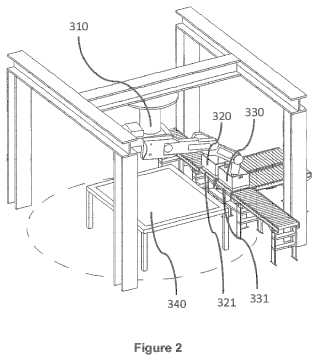
Increasingly we are seeing repetitive tasks carried out by workers being replaced by robotics. This can even involve skilled workers, such as bricklayers. Mark Pavic of Western Australia, an aeronautic and mechanical engineer has with a colleague devised a brick-laying machine.
The story is told in a Gizmag story, Brick-laying robot can build a full-sized house in two days. The robot, Hadrian, can lay 1000 bricks an hour. Pavic's brother Mike is CEO of Fastbrick Robotics who intend to launch a commerical version in 2017.
It was as long ago as 2007 hat the world patent application for the concept was published, WO2007/076581. Below is the main drawing.
So, how could you have found such a patent document ? The classification is based on the idea of "manipulators" which could be run together with the word brick* to get a good list of relevant material. B25J9, programme-controlled manipulators, looks particularly attractive.
Once you know of a patent document, you can check to see what happened to it in specific jurisdictions. In this case US8166727 was granted protection in 2012. The pan-European granted document, EP1977058B, was published in 2014, and the documents to do with its allowance are given in the relevant European Register entry.
Anyone wondering at the time if the patents would be allowed could have looked at the prior art as listed by patent examiners -- this is given as "cited documents" on the left hand side of the bibliographic entry for the European A document. 22 are listed for that one. It might be thought logical that all prior art cited is given there, but no, each "also published as" document needs to be clicked on and a fresh window appears. Some countries, such as the USA, do not list cited patents at the initial A stage but only at the granted, B stage.
Just as you can find the prior art by clicking on "cited documents", you can find those that later referred back to the one you know of by clicking on "citing documents". This tells us that none cited the European; but for the US A and also the B document there are 9, and for the original WO document there are 6. You would have to compare the lists to figure out which were on both lists -- they are likely to be particularly significant.
Those with specialist knowledge of the area would then have to interpret the results, so long as those who understand the published patent documentation and its associated patent procedure can explain what to look out for and implications. Both are needed. When I worked in the area, it always surprised me how many inventors thought that they could do it all themselves, or just spend 20 minutes or so looking through the patents before committing to thousands of pounds of expenditure and huge amounts of time. Rather like carrying out brain surgery on yourself, perhaps ?
I retired in April 2013 after 25 years as a librarian at the British Library specialising in inventions. This included running numerous workshops; writing books on inventions and a work blog; carrying out searches for clients; and one-to-one meetings with inventors. [more]
[ABOUT ME] [CONSULTANCY WORK] [FAVOURITE LINKS] [BOOKS] [CONTACT]
13 January 2016
11 January 2016
Unventional: Ideas too good to patent, book review
Some books about inventions are serious and are designed to enlarge knowledge. Some books about inventions inspire.
And then other books are just plain fun. Madcap, even.
Unventional: Ideas too good to patent by Tom Giesler is definitely in the last category, with madcap humour and superb drawings of Rube Goldberg-like (or, in the UK, Heath Robinson) inventions which are just a bit wacky. They are in the same style as many real patent draftsmen working for inventors to show how the inventions work. This is not a coincidence: besides being an artist, Giesler is himself a patent draftsman. And he even lives in California -- isn't that the place where the crazies come from ? (Just kidding, my wife grew up there).
When I was a patent specialist at the British Library, I had to emphasize how serious and important inventions were, and keep a straight face when someone explained a silly idea. No longer ! Freeze-cones, diaper bowls, burger sheaths -- inventions no one is likely to really need are seriously explained, thought through and illustrated here just as much as worthwhile inventions are explained in the Real Thing on numerous databases. It's the sort of book I'd have loved to have written if I had any artistic talent at all.
Below is a delightful, short trailer about the book.
The book can be bought through the Unventional website.
And then other books are just plain fun. Madcap, even.
Unventional: Ideas too good to patent by Tom Giesler is definitely in the last category, with madcap humour and superb drawings of Rube Goldberg-like (or, in the UK, Heath Robinson) inventions which are just a bit wacky. They are in the same style as many real patent draftsmen working for inventors to show how the inventions work. This is not a coincidence: besides being an artist, Giesler is himself a patent draftsman. And he even lives in California -- isn't that the place where the crazies come from ? (Just kidding, my wife grew up there).
When I was a patent specialist at the British Library, I had to emphasize how serious and important inventions were, and keep a straight face when someone explained a silly idea. No longer ! Freeze-cones, diaper bowls, burger sheaths -- inventions no one is likely to really need are seriously explained, thought through and illustrated here just as much as worthwhile inventions are explained in the Real Thing on numerous databases. It's the sort of book I'd have loved to have written if I had any artistic talent at all.
Below is a delightful, short trailer about the book.
The book can be bought through the Unventional website.
1 December 2015
Ocado, the UK online grocer
Ocado is the leading UK online grocer. Its business consists in trying to make money from packing groceries and related items for customers and delivering it to their homes,
I remember being skeptical about their business model when they started in 2000, founded by three former merchant bankers from Goldman Sachs. From 2002 they worked in partnership with Waitrose, an upmarket supermarket chain, and in 2010 they were floated on the stock exchange. I see that in 2014 on a revenue of £948 million they had a razor-thin profit before tax of £7 million -- a margin of under 1%.
Clearly, controlling their costs is crucial as there is only just so much that customers are willing to pay as a premium for having their groceries delivered. They only have two warehouses: one in Hertfordshire, and the other in Warwickshire. Inventions have been used to ensure an efficient environment for collecting the groceries to fulfil the orders.
This is a list of British patent specifications by Ocado.
Here are a few of the drawings. A picking station:
This is for units that move in two directions above the storage units:
At the time of writing, eight out of ten documents found had as the inventor, or one of the inventors, a Swede called Lars Lindbo. Very often, when a company's technology is of interest, it turns out that there are one or two significant inventors who might perhaps be poached.
Their website, too, is simply a tool for ordering groceries and supplies, and has constant discount offers. It has features such as remembering what was ordered before so it is easy to reorder. When you are ready to check out you can select a time slot for delivery, 6 in the morning to 10 at night, whichever is best for you -- at no extra charge if you can be flexible by picking a time when the van is in your area. Disclosure: we have used it ourselves, with deliveries at say noon -- one of the perks of being retired.
I remember being skeptical about their business model when they started in 2000, founded by three former merchant bankers from Goldman Sachs. From 2002 they worked in partnership with Waitrose, an upmarket supermarket chain, and in 2010 they were floated on the stock exchange. I see that in 2014 on a revenue of £948 million they had a razor-thin profit before tax of £7 million -- a margin of under 1%.
Clearly, controlling their costs is crucial as there is only just so much that customers are willing to pay as a premium for having their groceries delivered. They only have two warehouses: one in Hertfordshire, and the other in Warwickshire. Inventions have been used to ensure an efficient environment for collecting the groceries to fulfil the orders.
This is a list of British patent specifications by Ocado.
Here are a few of the drawings. A picking station:
This is for units that move in two directions above the storage units:
At the time of writing, eight out of ten documents found had as the inventor, or one of the inventors, a Swede called Lars Lindbo. Very often, when a company's technology is of interest, it turns out that there are one or two significant inventors who might perhaps be poached.
Their website, too, is simply a tool for ordering groceries and supplies, and has constant discount offers. It has features such as remembering what was ordered before so it is easy to reorder. When you are ready to check out you can select a time slot for delivery, 6 in the morning to 10 at night, whichever is best for you -- at no extra charge if you can be flexible by picking a time when the van is in your area. Disclosure: we have used it ourselves, with deliveries at say noon -- one of the perks of being retired.
29 November 2015
The problems of private inventors: "New Scientist" in 1979-80
In looking up a reference recently I came across a couple of articles on British private inventors in New Scientist dating back to 1979-80 (freely available on Google Books).
They were about the frustrations experienced by inventors trying to get their ideas commercialised. Things haven't changed: my career as a patent librarian began in 1987 and ended with my retirement in 2013, and complaints about a lack of enthusiasm for private inventors' ideas were a constant refrain.
The articles reminded me that many inventors would say to me that the government should pay for evaluating, promoting and often financing their inventions. Strangely, none of them volunteered that the government would then deserve a big cut of any profits for taking such risks. I always felt that many private inventors were unable to understand the feelings and motivations of those on the other side of a bargaining table, and that success was very unlikely without some empathy.
The articles I found were both by Adrian Hope, who in 1980 revealed himself to be Barry Fox, a journalist who specialised in electronics and who took a great interest in the patent system. They are It's a wonderful idea, but... (1 June 1978, 576-581) and Death of an idea (13 September 1979, 794-797, with comments by inventors in the 27 September issue, page 1000, Hope springs eternal).
They make entertaining reading, if it is rather frustrating to see good ideas that at the time at least never got anywhere. The first article was promoting the idea of an organisation that would "provide desperately needed funds and encouragement" for selected inventions by private inventors. The problem, surely, would be to identify the possible winners: if it was that easy, everyone would be doing it.
The article began with Hope explaining that he wrote to the inventors of 65 patented inventions which had been profiled by him in New Scientist. 29 of them were still in force (occasional renewal fees were required), 20 had lapsed from protection, the remainder were too new to be subject to renewal fees. Only 33 replied, although Hope used the latest addresses as listed in the Patent Register.
Of the 28 replies relating to "small" inventions, 8 were handwritten, and many were rambling and mentioned irrelevant matters (I always reminded inventors that no manufacturer would be interested in how or why you thought of the idea...). Hardly business-like, and I liked Hope's comment that inventors can be their own worst enemies. What they had in common was that they were frustrated by the "brickwalls" in trying to get the idea into production or use.
One such invention was GB1288677, Means for protecting water pipes from bursting under freezing conditions, a simple means of doing just that. Another was a musical potty to help mentally disabled children, GB1409803, Chamber pot. That may sound amusing to some, but a woman inventor later made a lot of money from such a device that talked to the children to encourage, ahem, good aim. This is a list of mostly relevant patent documents on talking or musical potties.
The article concluded by recommending a scheme by which prizes of £5000 would be awarded after evaluation. The National Research Development Corporation (NRDC) had a somewhat similar role but for larger-scale inventions, and it was disquieting that many inventors said at the time that they had never head of it.
The second article was an interesting followup. The NRDC was only interested in strongly protected inventions, often not the case for small inventions, and they needed to be potentially valuable. Their investment in the hovercraft had not earned money, and apparently it was only their investment in patents in cephalosporin drugs which had made it profitable. Which confirms my point that it is very hard to pick out the "winners". Perhaps only inventions which save money for the user or the taxpayer, or which help the environment, should be picked ?
The NRDC is no more, and Nesta, founded in 1998, is the UK agency which comes closest to it, although with a wider remit. Its Our history pages list some of its achievements.
There is also the idea of a Royal Academy of Invention, for evaluating inventions, which has been promoted by Trevor Baylis, the "clockwork radio" inventor. He has not made much progress with the concept.
So, business as usual...
They were about the frustrations experienced by inventors trying to get their ideas commercialised. Things haven't changed: my career as a patent librarian began in 1987 and ended with my retirement in 2013, and complaints about a lack of enthusiasm for private inventors' ideas were a constant refrain.
The articles reminded me that many inventors would say to me that the government should pay for evaluating, promoting and often financing their inventions. Strangely, none of them volunteered that the government would then deserve a big cut of any profits for taking such risks. I always felt that many private inventors were unable to understand the feelings and motivations of those on the other side of a bargaining table, and that success was very unlikely without some empathy.
The articles I found were both by Adrian Hope, who in 1980 revealed himself to be Barry Fox, a journalist who specialised in electronics and who took a great interest in the patent system. They are It's a wonderful idea, but... (1 June 1978, 576-581) and Death of an idea (13 September 1979, 794-797, with comments by inventors in the 27 September issue, page 1000, Hope springs eternal).
They make entertaining reading, if it is rather frustrating to see good ideas that at the time at least never got anywhere. The first article was promoting the idea of an organisation that would "provide desperately needed funds and encouragement" for selected inventions by private inventors. The problem, surely, would be to identify the possible winners: if it was that easy, everyone would be doing it.
The article began with Hope explaining that he wrote to the inventors of 65 patented inventions which had been profiled by him in New Scientist. 29 of them were still in force (occasional renewal fees were required), 20 had lapsed from protection, the remainder were too new to be subject to renewal fees. Only 33 replied, although Hope used the latest addresses as listed in the Patent Register.
Of the 28 replies relating to "small" inventions, 8 were handwritten, and many were rambling and mentioned irrelevant matters (I always reminded inventors that no manufacturer would be interested in how or why you thought of the idea...). Hardly business-like, and I liked Hope's comment that inventors can be their own worst enemies. What they had in common was that they were frustrated by the "brickwalls" in trying to get the idea into production or use.
One such invention was GB1288677, Means for protecting water pipes from bursting under freezing conditions, a simple means of doing just that. Another was a musical potty to help mentally disabled children, GB1409803, Chamber pot. That may sound amusing to some, but a woman inventor later made a lot of money from such a device that talked to the children to encourage, ahem, good aim. This is a list of mostly relevant patent documents on talking or musical potties.
The article concluded by recommending a scheme by which prizes of £5000 would be awarded after evaluation. The National Research Development Corporation (NRDC) had a somewhat similar role but for larger-scale inventions, and it was disquieting that many inventors said at the time that they had never head of it.
The second article was an interesting followup. The NRDC was only interested in strongly protected inventions, often not the case for small inventions, and they needed to be potentially valuable. Their investment in the hovercraft had not earned money, and apparently it was only their investment in patents in cephalosporin drugs which had made it profitable. Which confirms my point that it is very hard to pick out the "winners". Perhaps only inventions which save money for the user or the taxpayer, or which help the environment, should be picked ?
The NRDC is no more, and Nesta, founded in 1998, is the UK agency which comes closest to it, although with a wider remit. Its Our history pages list some of its achievements.
There is also the idea of a Royal Academy of Invention, for evaluating inventions, which has been promoted by Trevor Baylis, the "clockwork radio" inventor. He has not made much progress with the concept.
So, business as usual...
22 August 2015
Adaptahaus: Grand Designs and a prototype house
I've just been watching an old Grand Designs episode about Alan Dawson's prototype house, Adaptahaus. It was built in Cumbria in a few weeks, back in 2009.
Presumably named for the super-ecological Passivhaus concept from Germany, it is an ingenious way of building efficient houses in high volume. This is what the finished product looked like: it cost about half a million pounds although that included prototype work.
The idea was that the floors would be built on a grid basis to make things quicker and easier -- rather as in Japan rooms are measured by the number of tatami mats needed to cover the floors. Hence wooden spans were noticeable at set intervals in big rooms. Personally I found it a pleasing pattern.
Alan also applied for a patent, in May 2010 (odd if the episode was shown in 2009, as patent applications are made for new concepts, not those disclosed in TV programmes). An international patent application was published as Pre-fabricated building structure. Here's one of the drawings from it.
It was, however, withdrawn in 2012 as a European patent application and doesn't seem to have been granted elsewhere. This was presumably because three patent documents, two French and one Dutch (but in English), were found to have anticipated what Dawson's application was claiming protection for, as listed in this list, which also includes patent documents he was aware of. It shows how hard it is to look for prior art even though Dawson used a patent attorney. The French documents were more than 20 years old and hence could not be used to take legal action against Dawson, while the more recent Dutch application turned out to also be deemed withdrawn as they had not replied in time -- perhaps the list of documents in the European Patent Office correspondence offers hints. This was the sort of thing I was looking up for people all the time when I worked in the British Library.
Adaptahaus has its own website.
Presumably named for the super-ecological Passivhaus concept from Germany, it is an ingenious way of building efficient houses in high volume. This is what the finished product looked like: it cost about half a million pounds although that included prototype work.
The idea was that the floors would be built on a grid basis to make things quicker and easier -- rather as in Japan rooms are measured by the number of tatami mats needed to cover the floors. Hence wooden spans were noticeable at set intervals in big rooms. Personally I found it a pleasing pattern.
Alan also applied for a patent, in May 2010 (odd if the episode was shown in 2009, as patent applications are made for new concepts, not those disclosed in TV programmes). An international patent application was published as Pre-fabricated building structure. Here's one of the drawings from it.
It was, however, withdrawn in 2012 as a European patent application and doesn't seem to have been granted elsewhere. This was presumably because three patent documents, two French and one Dutch (but in English), were found to have anticipated what Dawson's application was claiming protection for, as listed in this list, which also includes patent documents he was aware of. It shows how hard it is to look for prior art even though Dawson used a patent attorney. The French documents were more than 20 years old and hence could not be used to take legal action against Dawson, while the more recent Dutch application turned out to also be deemed withdrawn as they had not replied in time -- perhaps the list of documents in the European Patent Office correspondence offers hints. This was the sort of thing I was looking up for people all the time when I worked in the British Library.
Adaptahaus has its own website.
11 June 2015
A patent dispute: Eustace Vant and his father in law
It is unusual for patent disputes to involve taking your father in law to court. Here's a British one from World War I.
My source is the Evening Dispatch of the 20 July 1916, as found on the British Newspaper Archive while investigating Surbiton in World War I. Eustace Hazzel Vant had been a Captain in the Loyal North Lancashire Regiment who had been invalided out after being thrown from a horse. In 1915 he married Sybil Barton.
The 1911 census shows Sybil as a secretary for a ladies' club, age 26, living on Bond Street with a married typist. Her parents were in a 11 room house called Brooklands, in Lingfield, Surrey. Joshua Barton was 59, a company director of a match factory, living with his wife Annie.
Then on the 20 July 1916 a court case erupted in the King's Bench.
The 1911 census shows Sybil as a secretary for a ladies' club, age 26, living on Bond Street with a married typist. Her parents were in a 11 room house called Brooklands, in Lingfield, Surrey. Joshua Barton was 59, a company director of a match factory, living with his wife Annie.
Then on the 20 July 1916 a court case erupted in the King's Bench.
Vant, of Surbiton, had given his father in law, Joshua Barton of next-door Kingston, Surrey, £100. That was not in dispute: what was uncertain was whether or not it was a loan, as Vant insisted, or an investment, as Barton asserted.
Vant claimed that half of the sum was to be repaid in November 1915 and the balance in February 1916. He had obtained an overdraft from his bank on which he had to pay interest.
Barton argued that the money was an investment in a collapsible lifeboat. It was agreed that Vant had tried to get the authorities interested in the invention, including a visit to Liverpool which cost him £4 in expenses (for which he was refunded).
It sounds as if they did not have a written agreement, which was very foolish of both men, and is in fact close to unbelievable. Barton seems to have been well off and it is strange that he needed £100 from his son in law.
Although the news account does not say so, it appears that Barton was the actual inventor. A few weeks after the sinking of the Titanic, GB1912/10787, Improvements in collapsable lifeboats, was filed by Joshua Barton of Brooklands, Lingfield, Surrey, director of a public company. A drawing from it is shown below.
Together with an engineer named Charles Hibberd he had been responsible for three earlier patents for cash registers and the like, and also for an earlier lifeboat invention, GB 1898/26927,
So what happened ? The newspaper account only gives us the fact that the court case was on-going and not its conclusion. Not surprisingly, the marriage appears to have broken up. Vant remarried in 1918 and became a solicitor in the family firm in Settle, Yorkshire, and died in 1948,
6 April 2015
Stephen Hawking as a registered trade mark
Stephen Hawking, the eminent Cambridge professor, applied on the 2 March 2015 for his own name as a trade mark in a number of activities.
You can register your name as a trade mark under UK law, or an agent or company can do so on your behalf. Anyone else trying to do so is guilty of "bad faith". I remember someone coming into the British Library saying he wanted to register the names of the Beatles. We checked, and three, I think, had registered their names (there's certainly Paul McCartney and Ringo Starr).
Hawking's applications are UK00003097042 and UK00003097043 which between them cover seven classes of named activities. Having classes means that a trade mark like Swan can be used for a variety of services or product and not just by one company covering all activities.
If registered, they will only be valid for the UK, but the option is available under the Paris Convention to apply for protection in for example the USA or the European Union provided this is done within 6 months. It is still possible to do so beyond six months, but if someone else applies before you do then you lose out.
According to an article on the LiveScience website, Stephen Hawking wants to trade mark his name, by Tanya Lewis, Hawking's intention is to block someone else trying to use his name to sell in the areas listed in the applications.
A few years ago I posted on my old work blog about David Beckham and his wife Victoria as brands, where they and their advisors made very effective use of the intellectual property system, including registering David's signature. Quite a few people have done so. Paul Gascoigne, the retired footballer, applied for a number of UK trade marks, all now "dead" and not valid, and several bearing his signature, as shown below in the list of results.
He still has a valid registration in Europe, EU010619732.
Other celebrities who have registered their name or signature include Olivia Newton-John, Alex Ferguson, Ozzy Osbourne... and also Ed Milliband, who was registered by the Labour Party in 2011.
I imagine that it gets more tricky in law when the name is of someone who is dead, such as Ella Fitzgerald and Michael Jackson, who besides registrations when he was alive such as a 1985 filing, had a filing made months after his death.
The UK jurisdiction has had a number of disputes about the right to use a name, or a trade mark close to a name, such as Albert Einstein, Jane Austen, Elvis Presley and Marlene Dietrich. There is also a European-wide case regarding Pablo Picasso.
Fictional characters and the names of teams or other entities or television programmes can also be involved in disputes over who has the right to use it in commerce. It all comes under the umbrella term of "character merchandising."
It reminds me of a 1920s court case when a man called Albert Hall decided to form an orchestra. In those days it was normal to call an orchestra after the leader, so he called it the Albert Hall Orchestra. He was taken to court by the Royal Albert Hall who claimed that he was trying to give the impression that he was connected with them. The judge, finding for the defendant, said that if you were called Albert Hall it was perfectly reasonable that you would call your orchestra the Albert Hall Orchestra.
However, a man called Henry Harrod who opened a business in New Zealand and called it Harrods was opposed by the famous department store. Apparently people might have thought that there was a connection. The action was dropped when many businesses in the town changed their name similarly, and indeed the town changed its name temporarily to Harrodsville.
You can register your name as a trade mark under UK law, or an agent or company can do so on your behalf. Anyone else trying to do so is guilty of "bad faith". I remember someone coming into the British Library saying he wanted to register the names of the Beatles. We checked, and three, I think, had registered their names (there's certainly Paul McCartney and Ringo Starr).
Hawking's applications are UK00003097042 and UK00003097043 which between them cover seven classes of named activities. Having classes means that a trade mark like Swan can be used for a variety of services or product and not just by one company covering all activities.
If registered, they will only be valid for the UK, but the option is available under the Paris Convention to apply for protection in for example the USA or the European Union provided this is done within 6 months. It is still possible to do so beyond six months, but if someone else applies before you do then you lose out.
According to an article on the LiveScience website, Stephen Hawking wants to trade mark his name, by Tanya Lewis, Hawking's intention is to block someone else trying to use his name to sell in the areas listed in the applications.
A few years ago I posted on my old work blog about David Beckham and his wife Victoria as brands, where they and their advisors made very effective use of the intellectual property system, including registering David's signature. Quite a few people have done so. Paul Gascoigne, the retired footballer, applied for a number of UK trade marks, all now "dead" and not valid, and several bearing his signature, as shown below in the list of results.
He still has a valid registration in Europe, EU010619732.
Other celebrities who have registered their name or signature include Olivia Newton-John, Alex Ferguson, Ozzy Osbourne... and also Ed Milliband, who was registered by the Labour Party in 2011.
I imagine that it gets more tricky in law when the name is of someone who is dead, such as Ella Fitzgerald and Michael Jackson, who besides registrations when he was alive such as a 1985 filing, had a filing made months after his death.
The UK jurisdiction has had a number of disputes about the right to use a name, or a trade mark close to a name, such as Albert Einstein, Jane Austen, Elvis Presley and Marlene Dietrich. There is also a European-wide case regarding Pablo Picasso.
Fictional characters and the names of teams or other entities or television programmes can also be involved in disputes over who has the right to use it in commerce. It all comes under the umbrella term of "character merchandising."
It reminds me of a 1920s court case when a man called Albert Hall decided to form an orchestra. In those days it was normal to call an orchestra after the leader, so he called it the Albert Hall Orchestra. He was taken to court by the Royal Albert Hall who claimed that he was trying to give the impression that he was connected with them. The judge, finding for the defendant, said that if you were called Albert Hall it was perfectly reasonable that you would call your orchestra the Albert Hall Orchestra.
However, a man called Henry Harrod who opened a business in New Zealand and called it Harrods was opposed by the famous department store. Apparently people might have thought that there was a connection. The action was dropped when many businesses in the town changed their name similarly, and indeed the town changed its name temporarily to Harrodsville.
28 March 2015
Kingston University "Dragons' Den" final
I've just ended my year as a mentor at Kingston University where teams of business students try to run a microbusiness.
The final evening consisted of each team going before one of several panels of "dragons" with a seven minute presentation followed by seven minutes of questions. Six survived to be recommended for a pitching competition, and they had to present for just three minutes before everyone (including the other students) from which two were nominated for a national competition at Manchester. All this is under the banner of Young Enterprise.
The six to get to the second stage were
Fli, headphones and blindfold for use when flying
Oliver George S.A, limited edition watches
Little Steps, who have an animated film for their Ella product, a sloping cushion for babycare
Speacup who have a cute film, stickers that reveal messages in hot drinks
Beebra, a sports bra
Brace Yourself (my team), which makes athletes with bad backs stand up straighter
The winners were Fli and Beebra. Well done ! I liked the films and role play that some of the finalists used to dramatise the products.
I'm sure the students found it a fantastic journey, if a bit of a rollercoaster. We mentors gave them a hard during the year and on the evening -- it's easier to spot omissions if you're not involved -- but realised that they had to learn about concepts like clearly expressing what their product was about, and covering all the major points in product design, finance, marketing and future plans. I did notice on the evening that many of the teams wasted precious time in making interesting but irrelevant comments.
I certainly learnt from it, and picked up some business information of my own, if only from the other mentors.
The final evening consisted of each team going before one of several panels of "dragons" with a seven minute presentation followed by seven minutes of questions. Six survived to be recommended for a pitching competition, and they had to present for just three minutes before everyone (including the other students) from which two were nominated for a national competition at Manchester. All this is under the banner of Young Enterprise.
The six to get to the second stage were
Fli, headphones and blindfold for use when flying
Oliver George S.A, limited edition watches
Little Steps, who have an animated film for their Ella product, a sloping cushion for babycare
Speacup who have a cute film, stickers that reveal messages in hot drinks
Beebra, a sports bra
Brace Yourself (my team), which makes athletes with bad backs stand up straighter
The winners were Fli and Beebra. Well done ! I liked the films and role play that some of the finalists used to dramatise the products.
I'm sure the students found it a fantastic journey, if a bit of a rollercoaster. We mentors gave them a hard during the year and on the evening -- it's easier to spot omissions if you're not involved -- but realised that they had to learn about concepts like clearly expressing what their product was about, and covering all the major points in product design, finance, marketing and future plans. I did notice on the evening that many of the teams wasted precious time in making interesting but irrelevant comments.
I certainly learnt from it, and picked up some business information of my own, if only from the other mentors.
20 March 2015
Talk on women inventors at London
On Monday 13 April I will be giving a talk on women inventors in Kingston, a suburb of London, UK. It is part of the programme of the University of the Third Age's Kingston branch.
I have been interested in the topic since, many years ago, I was asked how to identify women inventors in the Victorian era by Deborah Jaffé, later the author of Ingenious women (2003). I remember the moment vividly, and have found the problem of identifying them fascinating ever since.
I will be using many illustrations, mainly from the late Victorian and Edwardian periods, to show the typical (or amusing) patents that women were responsible. As they were denied the opportunity to become engineers, they tended to cover what I call the Three Cs: Clothing, Cooking and Cleaning. I will also talk about many they were in comparison with men, and will feature some leading inventors.
The talk will be at 2 pm at the United Reformed Church, Union Street, above 5 minutes' walk from Kingston railway station. Non-members are charged £2 for admission.
I have been interested in the topic since, many years ago, I was asked how to identify women inventors in the Victorian era by Deborah Jaffé, later the author of Ingenious women (2003). I remember the moment vividly, and have found the problem of identifying them fascinating ever since.
I will be using many illustrations, mainly from the late Victorian and Edwardian periods, to show the typical (or amusing) patents that women were responsible. As they were denied the opportunity to become engineers, they tended to cover what I call the Three Cs: Clothing, Cooking and Cleaning. I will also talk about many they were in comparison with men, and will feature some leading inventors.
The talk will be at 2 pm at the United Reformed Church, Union Street, above 5 minutes' walk from Kingston railway station. Non-members are charged £2 for admission.
13 March 2015
British patents now available online at British Library
The UK Intellectual Property Office (IPO) has made available at the British Library, London PDFs of British patent specifications from 1617 to 1899 via a server located there. It is best to visit its Business & IP Centre to see them (and remember a pass is needed for entry to the library).
They are only accessible by asking for specific patent numbers rather than by using e.g. name, address, occupation or title. It is nevertheless a big advance on having to order paper copies and wait for them to be delivered. The entire specification loads very rapidly as a single PDF.
It also means that the paper copies at the IPO will be conserved from damage when requests for copies come in, besides the paper copies at the British Library.
I think it a shame it is not available elsewhere, such as at the patent libraries in the UK, or on the Web for anyone to use. Better still, it would have been good to have it added to the Espacenet database. There are precedents for having patents available only by using the patent number, such as early American and German patents.
At present Espacenet allows British patents to be requested from mid 1893. They can be ordered by patent number or by asking for GB in the publication number field and then by various other fields such as title and name.
They are only accessible by asking for specific patent numbers rather than by using e.g. name, address, occupation or title. It is nevertheless a big advance on having to order paper copies and wait for them to be delivered. The entire specification loads very rapidly as a single PDF.
It also means that the paper copies at the IPO will be conserved from damage when requests for copies come in, besides the paper copies at the British Library.
I think it a shame it is not available elsewhere, such as at the patent libraries in the UK, or on the Web for anyone to use. Better still, it would have been good to have it added to the Espacenet database. There are precedents for having patents available only by using the patent number, such as early American and German patents.
At present Espacenet allows British patents to be requested from mid 1893. They can be ordered by patent number or by asking for GB in the publication number field and then by various other fields such as title and name.
Subscribe to:
Posts (Atom)